
Reflection Blog
Part 1 (Human-Generated Content): Before taking this module, the name digital marketing was just a name I gave to social post, search adds, and the random spam emails from a company you bought from once. Ten weeks later, I now see it as the modern business “lifeline”. To perfect digital marketing, it needs to be a constant flow of data that makes how a business creates their ads and their business image. This realization opened my eyes to the importance of digital marketing and how it functions in the real-world transforming business’s success rate.
One of my favorite lessons was learning to map the buyer’s journey in detail. I learned about all the stages: awareness, consideration, decision, and loyalty. These forced me to analyze customer needs and then match the business’s content to that, rather than just following what was trending for other businesses. Making short explainer videos to get someone’s attention, sending a personalized email to form a sense of loyalty, making a comparison guide so that people can see what they are choosing, and many more examples like that. Business’s need to stop just posting for the sake of it, they need to follow their data trends and make all their online content count. Data and strategy are the core of the success of digital marketing.
It was important for me to realize that there is no single “magic” platform. Every platform performs different for businesses. More modern businesses need to be looking into the more modern platforms whereas a mom and pa shop with an older crowd needs to cater to them more. What matters is matching the channel to the customer base. Tik tok has been used for many different companies that wouldn’t traditionally use it, drawing in a younger crowd to their company. That same company may simultaneously still be doing their regular commercials on tv to reach their older crowd that does not have access to Tik Tok. It’s all about finding a balance with your marketing. Finding a way to be consistently drawing new people, while simultaneously catering to your original customers. “It’s about sharing the right message in the right place at the right moment” (Forbes coaches council).
This course also taught me that tracking numbers only matters when the numbers match clear goals. My generation has been taught to focus solely on how many likes you get and what people thought about your post. After this course, I learned that I actually need to care about who the post reached, whether it was seen as reliable, how many sales the post brought me, etc. Adding tracking links, also known as UTMs, helps to tell me exactly where every interaction on my page came from, google analytics is there to break down each customer’s path throughout my page and where they stopped interacting. Data is the best guide of what your business should be doing and what it shouldn’t be doing. Your data can help determine your success. This course has taught me just how important that is.
Other than my professors’ lectures, working with the real platforms was the best teacher for me. Building a google ads campaign taught me that a small change can completely change who sees your ad. I have also used Canva in the past for quick brand visuals, but the more you use it to cater you audience the more they will interact with your company. Using WordPress has taught me just how easy it can be to get your website out into the world in a professional manner.
One of my favorite discussions in class was when we talked about ethics and social responsibility. The discussion sparked a lot of internal dialogue about what online ethics were. The comparison of is it your responsibility to protect your data or the company’s responsibility made me realize how many people have never actually had that thought. They don’t realize that when they put something out into the world, it is there forever, and it is THEIR words. It’s important to remember that you may post a joke for people where you live, but it reaches a whole other continent and is deemed offensive there.
In closing, this project has not just taught me how to make an ad or catchy content; it’s rewired how I think about the creation of content and the online success of businesses. I leave this class with a new toolset full of platforms, a head full of digital creations, and multiple ideas for the future.
Part 2 (AI-Generated Content) *ChatGPT*
Digital Communications & Customer Engagement: A Systemic Reappraisal
The contemporary business environment is characterized by accelerated digital convergence, rendering digital marketing not merely a promotional adjunct but a core strategic function. This evolution mandates an integrated framework that aligns brand objectives with omnichannel execution, data governance, and ethical stewardship.
1.) Redefining the Role of Digital Marketing
Digital marketing now operates as a dynamic feedback ecosystem. Bidirectional data flows enable rapid iteration of product features, pricing structures, and messaging architecture, thereby collapsing traditional silos between marketing, operations, and R‑and‑D.
2.) Channel Optimization Across the Buyer Journey
Optimal channel selection is contingent upon journey‑stage intent signals. Short‑form video (e.g., TikTok Top View, Instagram Reels) accelerates awareness generation, whereas long‑form SEO‑optimized content substantiates consideration, and lifecycle‑triggered email sequences facilitate loyalty reinforcement.
3.) Performance Measurement Paradigm Shift
The efficacy of digital initiatives is increasingly gauged through goal‑aligned metric frameworks rather than aggregated vanity indicators. Deployment of UTMs, GA4 event tracking, and machine‑learning attribution models transforms dashboards into prescriptive decision matrices.
4.) Platform Proficiency as Professional Capital
Competence with high‑impact platforms—Google Ads keyword match logic, Mailchimp multivariate testing, Semrush competitive gap analyses, Shopify CRO iterations—constitutes measurable professional capital, directly enhancing organizational agility.
5.) Ethical, Cultural, and Social Responsibility Imperatives
Regulatory evolution (GDPR, CCPA) and heightened consumer scrutiny elevate transparency, inclusivity, and accessibility from optional enhancements to non‑negotiable requisites. Ethical compliance and cultural resonance collectively reinforce brand equity and mitigate reputational risk.
Conclusion
Digital Communications & Customer Engagement have matured into an interdisciplinary domain that synthesizes strategic planning, technological fluency, quantitative analytics, and ethical consciousness. Organizations that harmonize these vectors are positioned to cultivate resilient competitive advantage in a fluctuating marketplace.
Part 3 (Amalgamated Content):
Digital marketing began this semester as little more than a loose collection of concepts in my mind—social posts, search ads, and the occasional promotional email that slipped past my spam filter. Ten weeks on, I understand it as the living pulse of a modern business. It is a constant stream of data and dialogue that decides what a company produces, how it speaks, and how quickly it can shift course when the market changes. ChatGPT, the AI tool I consulted for this reflection, labels the same idea an “integrated framework that aligns brand objectives with omnichannel execution, data governance, and ethical stewardship.” Though the wording is more technical, the essence matches my own discovery: digital is no longer an optional add‑on but the core of strategy itself.
One of the earliest breakthroughs came from mapping the buyer’s journey in detail. By breaking the path into awareness, consideration, decision, and loyalty, I was forced to abandon trend‑chasing and focus on what audiences actually need at each step. Short explainer videos now have a clear purpose—sparking interest. Comparison guides help prospects weigh their options. Personalized email flows sustain loyalty long after the first purchase. The AI output reinforced this structure, noting that short‑form video accelerates awareness while lifecycle‑triggered email sequences deepen retention. Whether expressed in my own plain language or in ChatGPT’s polished prose, the lesson is the same: every asset must have a job and a metric.
Equally important was learning that no single “magic” platform exists. TikTok reels may capture a Gen Z audience in seconds, while a well‑crafted newsletter comforts long‑time customers who never scroll social feeds. The real skill lies in pairing every channel with the right moment in the journey, ensuring that message, medium, and timing are perfectly aligned. The AI text refers to this as “channel optimization across the buyer journey.” I call it common sense informed by data, but the conclusion is identical: use the right tool for the right task.
My attitude toward metrics also transformed. Early dashboards dazzled me with impressions, likes, and bounce rates but told no useful story. Rebuilding those dashboards around reach, trust, and revenue—and tagging every link with a UTM parameter—turned vanity into insight. Google Analytics 4 funnels soon revealed exactly where interest died and sales faltered. ChatGPT describes this shift as a “performance‑measurement paradigm” that replaces vanity indicators with goal‑aligned frameworks. However phrased, data ceased to be a scoreboard and became a steering wheel.
Hands‑on practice cemented the theory. A minor tweak to keyword match types in Google Ads completely reshaped who saw an ad. Two slightly different subject lines in Mailchimp— “Fresh drop” versus “See what’s new”—nearly doubled opens. Canva’s brand kit, SEMrush’s keyword gap tool, and basic conversion‑rate tweaks in Shopify each added a skill I can use on day one of any marketing job. The AI notes that such platform proficiency constitutes “professional capital.” I agree competence with real tools is currency.
Perhaps the most profound change, though, came from confronting ethics, culture, and social responsibility. Discussions of dark‑pattern interfaces and data‑consent scandals forced me to rethink tactics I had never questioned. A class debate made it painfully clear that a joke that plays well in Ireland might offend an audience in Malaysia. ChatGPT echoes this warning, arguing that transparency, inclusivity, and accessibility have moved from nice‑to‑have to non‑negotiable. Accessible design, clear alt‑text, honest data practices—these are not competitive edges; they are the moral floor on which every digital strategy must stand.
In blending my lived experience with the AI’s formal analysis, I see more clearly than ever that effective digital communications sit at the crossroads of strategy, creativity, analytics, and ethics. I leave the module with a toolbox full of platforms, an analytical habit of mind, and a commitment to keeping the customer’s dignity at the center of every click and conversion.
Below I have embedded a short video (just under five minutes) in which I walk through these reflections and explain how the AI material shaped my thinking. If the embed does not load in your reader, the video can also be viewed directly on YouTube. https://youtu.be/nVNbWsOaprA
SEO Audit Blog
Creating a personal website is not only about sharing who I am, but also about crafting a professional digital presence that is clean, professional, and discoverable. As part of my Digital Communications and Customer Engagement project, I built a WordPress site designed to show who I am and what my skills and work experience are. This website is made to highlight what I bring to the table and what I can provide as a business or even for your business. This project also helped hone down on my SEO and digital marketing skills. The goal was to not only create a space that reflects who I am, but to create a space where people can interact with me about my skills and things they think I should work on more. The website itself is used to help build my personal portfolio while also growing my personal skill set.
Before using the SEO audit tool, I made sure my website had all the features needed for the project and to highlight who I am and what my skillset includes. The homepage has a 200-word biography that introduces who I am- my name academic background, program of study, skills, career goals, and hobbies, all alongside a link to my personal LinkedIn page. I then created a contact form with a customized email response that acknowledges inquires and offers next steps, demonstrating professionalism and engagement. I also developed a landing page aligned with the messaging used in my paid ad campaign. This features a clear sense of online branding and also opened my skillset to a new tool that is the creation of online branding and ad work. To monitor performance, I installed Google Analytics, Tag Manager, Search Console, and my LinkedIn Insight Tag. Lastly, I added relevant links (my LinkedIn) and visual elements that will enhance any user’s experience.
Once my website structure and content were as organized as I could have them, I submitted them for a review with the SEO audit using the ALL in One SEO (AISEO) tool. This plugin provided a detailed overview of my website’s performance from an SEO standpoint. My site got a score of 77/100, which is an “Excellent” rating. Having this score off the bat definitely reassured me that I was on the right track to making a successful website, but it also did tell me areas that need correction and additional things added.
The audit highlighted several strengths. My SEO title and meta description were both within the character count and clearly defined the page’s content. My homepage used one H1 tag- something I’ve learned is an important SEO practice. My overall structure was very clean and easy to navigate. Tools like Google Analytics and the LinkedIn tag were already in place and that shows that my site was built with engagement in mind. On top of that, I personally believe my site was very professional, very organized, and highlights my top skills while not being too descriptive to the point that someone gets bored and clicks off the website. However, there were also a few weaknesses. The audit noted that a few images were missing alt attributions. This is very important for a website like mine. It also noted that I did not have any H2 tags on my homepage. Without these subheadings, my content lacked a visual organization that is very important. This made it slightly harder for users and search engines to understand what my information was or even what my content was being used for in those situations. Additionally, although I had a LinkedIn plugin, other professional social media links were missing, this limited my site’s connectivity and reach. That was also the only advice from SEO audit that I did not follow, I want to keep my personal and private social medias for myself and not use them towards my branding image for a business individual (most of the content is about travel or being with friends).
After implementing these changes, I ran the AISEO audit once again to assess what it thought with my corrections. The results showed a decent improvement. The previously flagged issues with missing alt texts were resolved for the most part, and it recognized my new H2 tags. While the overall score remained a solid 77, the site now had a few more individual SEO checks that were completed and fewer flagged items. This made me more confident for my project submission and for giving this site to professional individuals because I knew it had the appropriate changes made to it. I also verified through Google Search Console that my website was being properly indexed. All in all, this helped me grow much more confident about my website and what was needed to make it the best for my future.
This process not only expanded my understanding of the SEO tool and how it works. It has taught me to make exact adjustments and to focus on the small things when it comes to building your own website. It’s important to be consistently updating how your project was structured and what needs to be done to make sure it engages in the best way possible with visitors. Tools like AIOSEO were insanely important in guiding this process and giving my specific results. This project has been so important for me because it grew my confidence on how to build an online presence in a professional manner. Joining the digital world is important for all people in the business environment, it is a crucial skill to survive.
Paid Media Blog
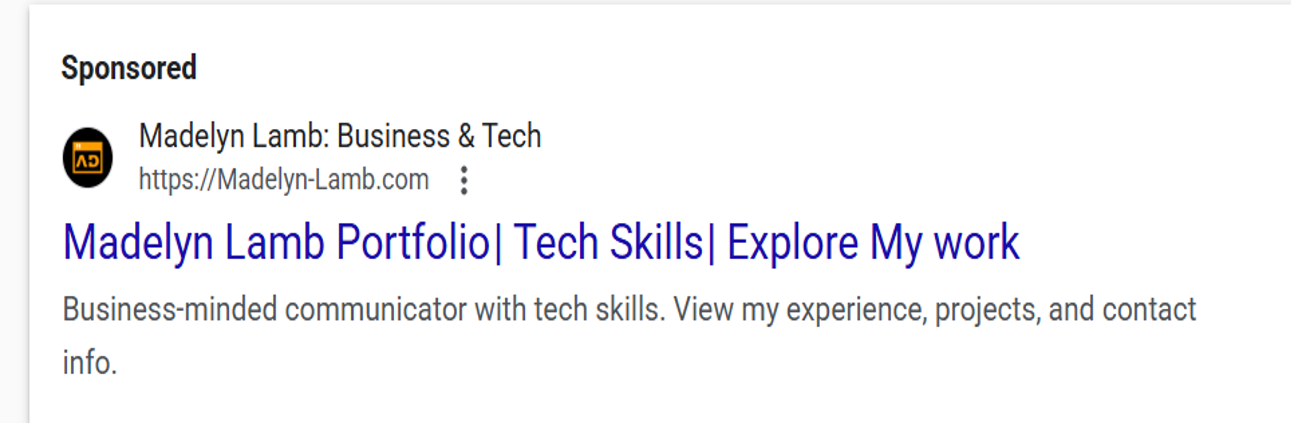
I created this Google Search ad to promote my personal portfolio website. The ad was designed to catch the attention of Business professionals and other professionals looking to connect with me. The ad’s objective was to drive traffic to my site that highlights my skillsets, professionalism, and communication skills. The wording for this ad is simple but very effective, it gives viewers a quick summary of what they’ll find on the landing page.
This ad is aimed at bringing business professionals, people looking for someone to hire, and recruiters looking for new talent in the digital communication or tech space. It targets an audience looking into hiring or even just in a consideration part of a new customer or business process. They are already looking for potential candidates or collaborators that are also ready to explore portfolios.
The ad leads to my homepage, which serves as my landing page. It includes a clear 200-word page of myself that describes me, my skills, and my professional history. It also includes a family friendly photo that displays me in a professional light. Since everything with this ad feels connected and professional, it helps visitors trust the site and get a good first impression of me. I truly believe that this is a solid display that plays hand in hand with my website because it keeps the professional tone with it.
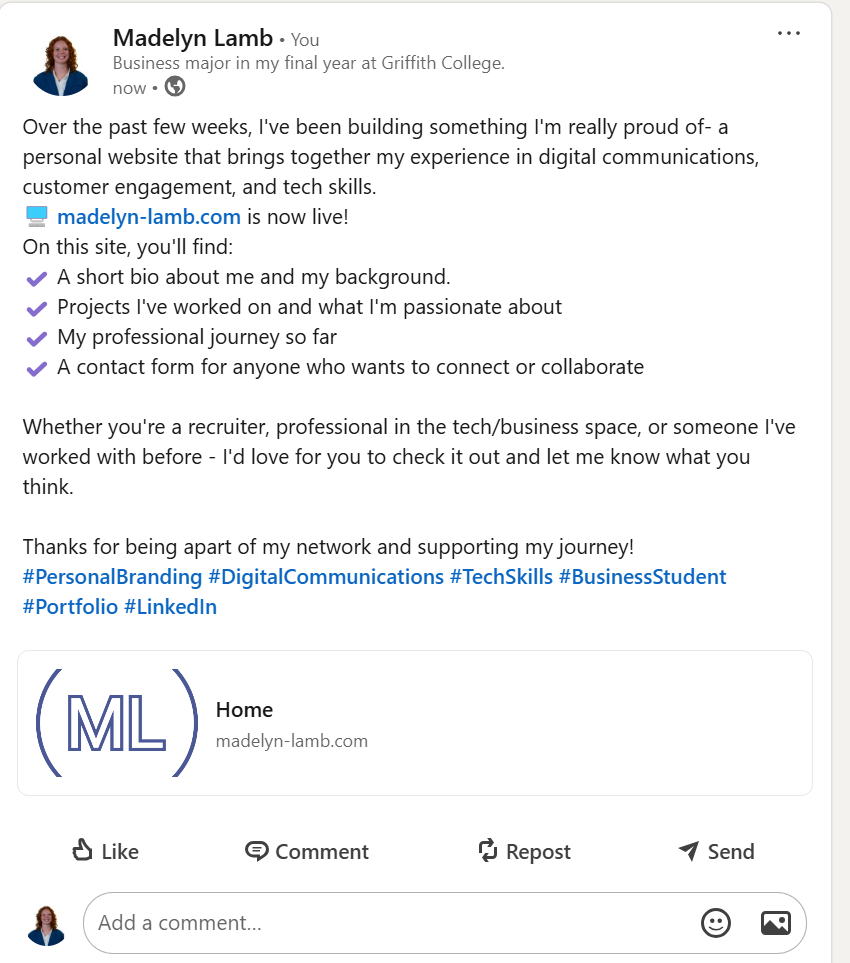
As part of digital communications project, I created a LinkedIn post to promote my personal portfolio website. This post was designed to engage my professional network and encourage people to get on my website to boost the data I get back about what works on my site and what doesn’t work on my site. I made this post so I could have my classmates, recruiters, mentors, and professionals in the tech or business space to see my work and experience and see whether it resonates with them or not. The post introduced my site in a friendly but professional tone, highlighting key elements such as a short biography, featured projects, my professional journey, and contact form for anyone interested in working together or learning more. The main objective of this LinkedIn post was to let my followers know and create awareness of my landing page. Unlike a paid ad, this organic approach focuses on relationship- building, leveraging the trust and familiarity of my existing network. The target audience includes anyone in my academic and professional circles. I’m especially attempting to target my connections that are hiring or connections that know someone who is hiring. This post is particularly useful for reaching people in the awareness or consideration stage of the customer journey. They may already know me or be interested in connecting with young professionals, and the post gives them a clear next step: to investigate my page and what I can offer and bring to the table. The link of my website provides a photo of my website’s logo. I feel like this is a glance into the professionalism and organization that will be found on my website. I try to portray the exact vibes I worked on building in my website through this post while simultaneously catering to the LinkedIn crowd and used all the mechanisms you are taught on how to maximize your LinkedIn post’s activity.
LinkedIn Optimization Blog
LinkedIn optimization is a process I started at the beginning of my college experience. It is a step forward into the business world that is crucial for all people in the business hierarchy. My optimization process started with building my LinkedIn page. I spent time to carefully craft all my school experience, work experience, and skills all onto my profile. I started with uploading a professional headshot as my profile picture and choosing a coordinating background for my background photo. I then worked on creating a professional, but short headline. I chose to include my major, school year, and the school I am attending. I then wrote in the “about” section. Here I included a short introduction to myself, an introduction to what I do on a daily basis to become a better student and future employee, and I highlighted my skills and what experience brought me to these skills. I then uploaded all of my school and work experience into the coordinating sections. These are all just the foundations of a LinkedIn, but I knew I needed to grow my connections to the best of my ability. To do this, I added my resume to the featured section and started taking as many online LinkedIn certifications as possible. Between that and my weekly LinkedIn post, I saw my account grow from 50 connections to 500+. Understanding how LinkedIn works, helps boost your profile in certain ways. Understanding relevant hashtags and emojis can even boost your post to show up more and be found at the top of your followings main post page.
Analytics Blog
As part of my Digital Communications and Customer Engagement (DCCE) project, I’ve been tracking my website’s performance using tools like Google Analytics, SEO site audits, and other tools around the same idea. This blog will share some of my key findings, including raw data from the website I created.
Over the past few weeks, my website has had 4 visitors in total, with no significant change throughout the weeks. The data shows that 50% of the visitors came directly to the website, meaning they either directly searched my URL in their search bar, or could potentially bookmarked my site. The other 50% of the visitors were categorized as “unassigned,” which means Google Analytics couldn’t identify the source of their visit. This lack of source tracking is something I will have to fix in the future to optimize my website’s success.
One of the most interesting insights I found was that my home-page. “madelyn-lamb.com Home,” has been the most visited page with the page views. This indicates that people are likely landing on the homepage when they first visit my site. Interestingly, it also had the highest engagement rate, with users spending a high average of time on it, which is a great sign of interest and interaction.
The second most visited page is the “Content” page, which received 6 pageviews. The engagement here is high, with a 100% engagement rate, meaning that all visitors who came to this page stayed for a good amount of time as well. This is honestly a really great result as it hints to me that people are interested in reaching out to connect.
Additionally, the last page, about being interested in working with me had 5 pageviews, and although its engagement rate is lower at 25%, it still shows a healthy amount of interest, with visitors spending an average of 17 minutes and 38 seconds. The “About Me” page saw 5 pageviews as well, with a 50% engagement rate.
In terms of SEO, my site currently holds a score of 80 out of 100, which is a solid result and a 10 point increase then when I first inputted my information from SEO into this blog. The audit identified 4 important issues that need to be addressed. 1 recommended improvement, and 16 positive results. Obviously, this makes me feel a lot more confident about my website, the higher it is ranked on SEO and Google Tag.
In the future, I’m going to prioritize working on improving the areas that SEO audit highlighted and work on getting perfect results from google tag manager. Understanding where my visitors are coming from will help me provide the best information and results for what my audience is looking for. Additionally, continuing to improve content and site performance will be important to keep my site having a growing audience.
In conclusion, while my website is off to a good start, there’s always room for optimization. The results I have gotten will help guide me moving forward with the success of my website and I’m excited to see how their continuous advice and results will help my website grow.